You’re staring at a message. Three letters. “IDEK.”
And your brain just stalls.
IDEK meaning in text isn’t immediately obvious the first time you see it. It feels like one of those abbreviations people expect you to just… know. No explanation. No context. Just dropped into a chat like it belongs there.
It doesn’t help that it shows up in the middle of emotional messages, jokes, even arguments. One second everything is normal. Next second IDEK and the tone shifts.
So what is it actually saying?
Let’s break it down properly, without overcomplicating it.
What Does IDEK Mean in Text?
IDEK stands for “I don’t even know.”
That’s it. Simple structure. Big emotional weight.
But the real meaning isn’t just the words it’s how people use it.
IDEK is a confusion expression, often loaded with frustration, disbelief, or being overwhelmed. It’s not a neutral statement like “IDK” (I don’t know). It hits harder. It stretches the feeling.
Think of it like this:
- IDK = unsure
- IDEK = mentally overloaded or emotionally stuck
It’s what people type when they can’t process what just happened, or when explaining feels pointless.
You’ll see it used in:
- messy conversations
- unexpected situations
- emotional reactions
- chaotic group chats
Sometimes it even replaces a full explanation.
Because the feeling is the explanation.
Where Is IDEK Commonly Used?
IDEK didn’t come from textbooks. It came from fast typing, late-night chats, and internet culture where speed beats grammar.
Today, it lives mostly in internet slang ecosystems.
You’ll find it everywhere people communicate casually:
- Text messaging between friends
- Direct messages on social apps
- Comment sections during viral moments
- Reaction posts and memes
It’s especially common on platforms like TikTok, where short, emotional reactions dominate conversations. People don’t want paragraphs. They want impact.
In places like Instagram DMs and Snapchat chats, IDEK shows up when someone doesn’t know how to respond properly but still wants to respond.
It fills the gap between silence and explanation.
And that gap is bigger than it looks.
IDEK vs IDK – The Difference Matters More Than You Think
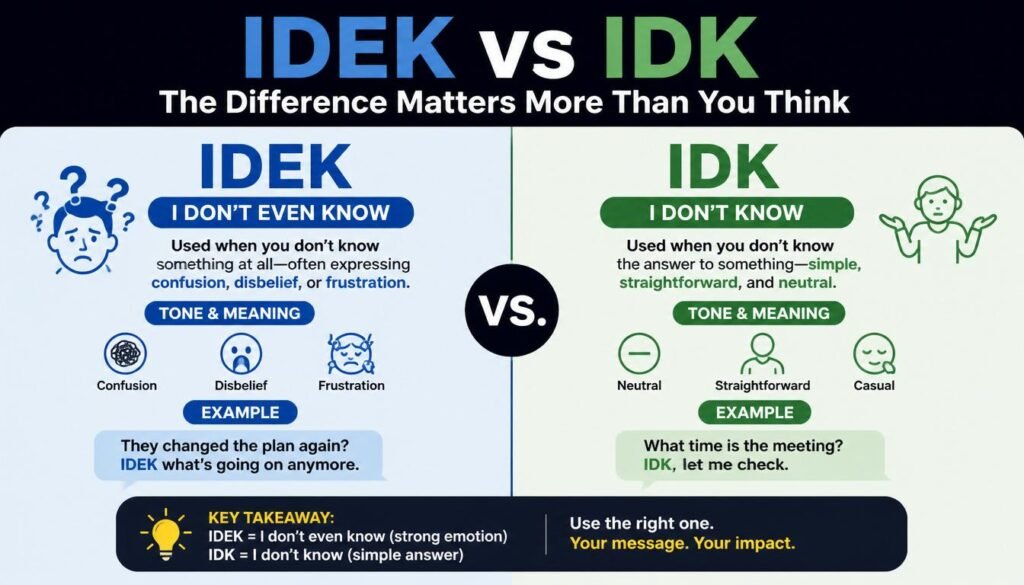
At first glance, IDEK and IDK look almost identical. One extra word. One extra layer.
But the emotional tone changes everything.
| Term | Meaning | Tone |
|---|---|---|
| IDK | I don’t know | Neutral, factual |
| IDEK | I don’t even know | Emotional, overwhelmed |
IDK is calm. It’s a shrug in text form.
IDEK is different. It’s what you say when:
- something makes no sense
- you’re mentally exhausted
- or the situation is too strange to process
Example:
- “Where’s the file?” → “IDK.”
- “Why did he do that?” → “IDEK…”
See the difference? One answers. The other reacts.
That reaction is the whole point.
How to Use IDEK in Real Conversations
IDEK works best when the situation is slightly chaotic or emotionally heavy.
Here’s how it actually shows up in real texting behavior:
Example 1: Confusion overload
A: “Did she really leave him after that?”
B: “IDEK, that whole situation is wild.”
Example 2: Unexpected news
A: “They canceled the trip last minute.”
B: “IDEK what’s going on anymore.”
Example 3: Humorous exaggeration
A: “Why is your dog wearing sunglasses?”
B: “IDEK… he thinks he’s famous.”
It’s flexible. But it always carries that same energy: confusion with attitude.
And sometimes, people don’t even add context after it. They just stop there.
That silence is intentional.
Is IDEK Slang or Informal Language?
IDEK is firmly part of internet slang, not formal English.
It belongs to the same category as other texting abbreviations that evolved from speed-based communication.
This matters because context decides everything.
You should not use IDEK in:
- academic writing
- job emails
- formal communication
But it fits naturally in:
- casual conversation
- group chats
- social media replies
- meme culture
It’s part of Gen Z language behavior, where emotion and speed matter more than grammatical structure.
And like most slang, it spreads through repetition, not instruction.
No one teaches it. People just absorb it.
Similar Internet Slang You Should Know
If IDEK makes sense now, you’re already halfway into modern texting language.
Here are related abbreviations that often appear in the same conversations:
- IDK – I don’t know (neutral uncertainty)
- TBH – to be honest (frank opinion)
- NGL – not gonna lie (truthful admission)
- FR – for real (agreement or emphasis)
- BRB – be right back (temporary exit)
These aren’t random. They form a kind of digital shorthand system.
Each one compresses emotion or intent into a few letters.
IDEK just happens to be one of the more expressive ones.
Why IDEK Became Popular Online

IDEK didn’t become viral because someone promoted it.
It spread because it solved a problem.
People needed a way to express:
- confusion without writing a paragraph
- emotional overload in one short phrase
- reaction without explanation
That’s the core of modern digital communication.
Add meme culture into the mix, and IDEK becomes even more powerful. It fits perfectly into screenshots, reaction posts, and comment chains where brevity wins.
Platforms like TikTok accelerated this behavior. Short-form content trains people to react quickly, not explain deeply.
IDEK fits that rhythm.
Fast. Emotional. Minimal effort.
Exactly how internet language evolves.
Frequently Asked Questions
What does IDEK mean in text messages?
IDEK means “I don’t even know,” used when someone feels confused, overwhelmed, or unable to explain a situation clearly.
Is IDEK the same as IDK?
Not exactly. IDK is neutral uncertainty. IDEK adds emotional weight and stronger confusion.
How do you use IDEK in a sentence?
You might say:
- “IDEK what just happened in that meeting.”
- “IDEK why he acted like that.”
- “IDEK anymore, this is too much.”
Is IDEK rude or offensive?
No. It’s not offensive. It’s informal slang used among friends or in casual online communication. Tone depends on context.
Where did IDEK come from?
It originated from early internet chat culture and evolved through texting and social media platforms where fast, emotional responses became normal.
What are similar slang words like IDEK?
Common related terms include IDK, TBH, NGL, FR, and BRB each serving a different role in casual digital conversation.
what does idek mean in text
IDEK means “I don’t even know.” It is used in texting when someone feels confused, shocked, or unable to explain a situation properly. It shows stronger emotion than a simple “IDK.”
what does idek mean in texting
In texting, IDEK is an internet slang abbreviation for “I don’t even know.” People use it when something feels too confusing or strange to understand or describe clearly.
what does idek
IDEK stands for “I don’t even know.” It is commonly used as a quick reaction in chats when someone is unsure, overwhelmed, or reacting to something unexpected.
what dose idek mean
IDEK means “I don’t even know.” It is informal slang used in online conversations to express confusion, disbelief, or not having an explanation for something.
Final Thought
IDEK isn’t just three letters.
It’s a snapshot of how people actually communicate online now fast, emotional, slightly chaotic, and heavily context-driven.
You don’t always need full sentences to express a full reaction anymore.
Sometimes, “IDEK” says it better than anything else could.
