
You’re staring at a message. Two letters. TS. No emoji, no extra context, nothing that gives you a hint. Just that. And your brain does that annoying little pause where it tries to decode it like some secret code you were never trained for. Yeah, that moment.
It happens more often than people admit. Texting moves fast, and abbreviations move even faster. TS is one of those slippery ones that refuses to stick to a single meaning. You’ll see it in a casual chat, a comment thread, maybe even a reply that feels slightly emotional depending on who’s typing.
Let’s untangle it properly.
What Does TS Mean in Text?
TS is not locked into one definition. That’s the first thing you need to know. It behaves more like a flexible shorthand than a fixed acronym.
In most conversations inside messaging apps like WhatsApp or Snapchat, TS usually bends toward something harmless and friendly. But depending on tone, region, and even the person typing, it can shift.
Here’s the reality: TS is context-driven internet slang. It doesn’t live in a dictionary with a single meaning carved in stone. It adapts.
And that’s exactly why people keep searching for it.
Most Common Meanings of TS in Chat
Let’s start with the interpretation you’ll probably see the most.
TS = Talk Soon
This is the clean, widely accepted meaning in everyday messaging.
When someone drops “TS,” they’re usually wrapping up a conversation without sounding abrupt. It’s a softer exit than just disappearing.
Example:
- “Gotta go now, TS.”
It carries a tone that sits somewhere between polite and casual. Not formal. Not cold. Just… “I’ll talk to you later.”
You’ll see this a lot in quick exchanges where people are multitasking, leaving school, heading into work, or just stepping away from their phone for a bit.
Other Possible Meanings of TS
Now things get a little less predictable.
TS can also shift depending on context. Some less common interpretations include:
- Tough Situation – used when reacting to something difficult someone shared
- True Story – sometimes used in conversational storytelling or reactions
- Team Speak – seen in gaming contexts, especially voice chat references
- Typing Style / Tone shorthand – in niche online groups
But here’s the catch. None of these are universal. If you assume wrong, you might misread the entire message.
That’s why TS always needs context.
TS Meaning on Different Platforms
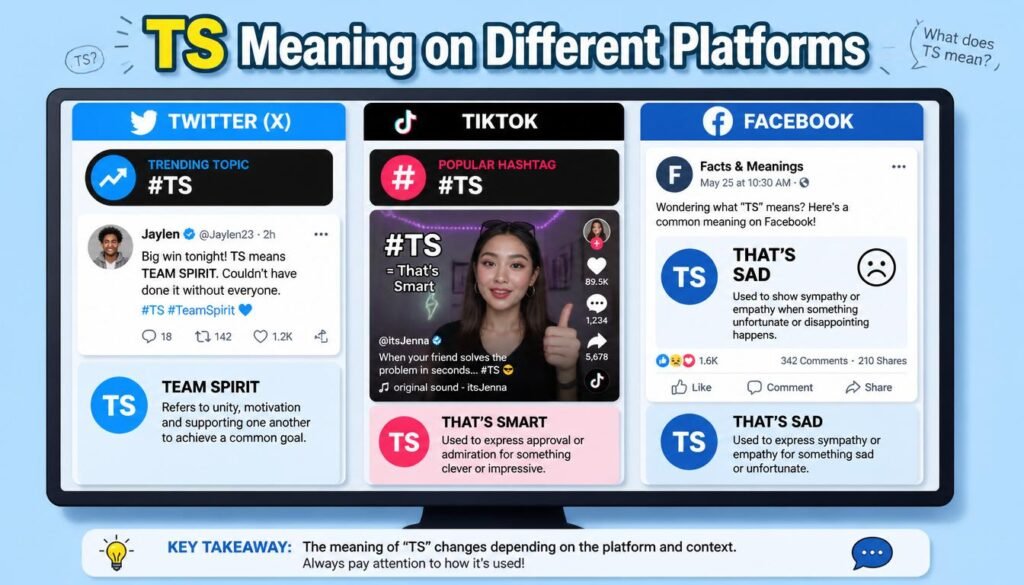
Where the abbreviation appears matters more than most people realize. The same two letters can behave differently depending on the app.
TS in WhatsApp Messages
Inside WhatsApp, TS most often leans toward “Talk Soon.”
Chats here are usually personal or semi-personal. Friends, family, classmates. The tone is conversational, so abbreviations are used to save time without sounding rude.
A typical flow:
- “I’m heading out now. TS.”
It’s quick, polite, and doesn’t kill the vibe of the conversation.
TS on Snapchat
Snapchat changes the game slightly. Messages are shorter, faster, and often more impulsive.
Here, TS can still mean “Talk Soon,” but you’ll also see it used as a quick filler or reaction depending on the conversation thread.
Because Snapchat messages disappear, people tend to keep things minimal. TS fits that pattern perfectly.
TS on TikTok Comments
Now we’re in public internet territory.
On TikTok, TS becomes more ambiguous. It can appear in comment threads where tone is harder to read. People often use shorthand like TS as reactions, replies, or emotional shortcuts.
In some cases, it’s still “Talk Soon,” but in others it can be part of a trend-specific slang layer that changes with communities and memes.
This is where confusion usually peaks.
How to Understand TS in a Conversation
If you want to stop guessing, you need to read between the lines. Not the word itself, but everything around it.
Here’s what actually helps:
- Look at the timing
If someone is leaving or ending a chat, “Talk Soon” is likely. - Check the topic
Emotional topic? It might mean “Tough Situation.” Casual goodbye? Probably “Talk Soon.” - Relationship matters
Friends use shorthand differently than coworkers or strangers. - Message flow before and after
The sentence before TS is your biggest clue. Always.
Think of TS like a shape-shifter. It borrows meaning from its surroundings.
📌 If you imagine it visually, it would look like a small word that changes color depending on the conversation around it. Same letters. Different emotion.
Is TS Always the Same Meaning?
No. And this is where most misunderstandings happen.
Internet slang is not stable. It evolves inside communities rather than official rulebooks. Unlike structured acronyms in formal communication, texting abbreviations grow organically through usage.
Platforms like Urban Dictionary often document these variations, but even there, meanings can conflict because users contribute definitions based on personal experience.
So TS behaves like this:
- Stable in casual texting (“Talk Soon”)
- Flexible in emotional or contextual replies
- Highly fluid in social media environments
That flexibility is the reason it spreads easily across apps like WhatsApp, Snapchat, and even comment sections on TikTok.
Related Internet Slang You Should Know

Once you understand TS, you’ll start noticing how similar abbreviations work the same way.
Here are a few that behave similarly:
- BRB – Be Right Back
- TTYL – Talk To You Later
- IDK – I Don’t Know
- BTW – By The Way
- IMO – In My Opinion
- SMH – Shaking My Head
They all belong to the same world: fast, compressed communication built for speed, not grammar perfection.
And honestly, that’s the point. People aren’t typing essays in chats. They’re moving thoughts quickly.
Frequently Asked Questions About TS Meaning in Text
What does TS mean in texting?
Most commonly, TS means “Talk Soon.” It’s used to politely end a conversation while signaling you’ll return later.
Does TS have more than one meaning in chat?
Yes. While “Talk Soon” is dominant, TS can also mean “Tough Situation” or other context-based phrases depending on tone and platform.
Is TS slang or an abbreviation?
It’s both. TS functions as an abbreviation in structured texting and as slang in informal online communication.
What does TS mean on Snapchat or TikTok?
On Snapchat, it usually keeps the “Talk Soon” meaning. On TikTok, it can vary depending on the comment thread and community tone.
How do I know what TS means in a message?
Look at context: timing, topic, and the relationship between speakers. Those clues almost always reveal the intended meaning.
Is TS offensive in any context?
Generally, no. Most uses are harmless. However, rare interpretations like “Tough Situation” may appear in emotionally sensitive conversations, depending on context.
what does ts mean in text
TS in text most commonly means “Talk Soon,” used when someone is ending a conversation but plans to chat again later. The exact meaning can still change depending on the context of the message.
what does ts mean in a text
In a text message, TS usually stands for “Talk Soon,” a casual way to say goodbye while keeping the conversation open. Sometimes, it can also have other meanings based on the situation or tone.
what is ts mean in text
“TS” in text generally means “Talk Soon,” used in informal chatting to signal a short break from conversation. However, its meaning can shift depending on the topic and context of the chat.
what ts mean in text
TS in text usually refers to “Talk Soon,” a quick and friendly way to end a conversation. The meaning is not fixed and can vary depending on how it is used in the message.
what do ts mean in text
“TS” in text typically means “Talk Soon,” indicating the person will talk again later. In some cases, it may also represent different meanings depending on the context of the conversation.
Final Thoughts on TS Meaning in Text
TS isn’t trying to confuse you. It’s just doing what internet language does best: adapting.
One moment it’s a friendly exit from a chat. Another moment it’s a reaction to something heavy. Same letters. Different weight.
If you take one thing from this, make it this: don’t translate TS in isolation. Read the message around it. That’s where the real meaning lives.
