You’re chatting with someone online, reading a funny comment, or scrolling through social media when you suddenly see “IMAO” at the end of a sentence. At first glance, it looks almost identical to LMAO, so you might wonder: is it a typo, a joke, or a completely different expression?
The truth behind IMAO meaning in text is more interesting than most people expect. Unlike many internet abbreviations that are created simply to save time, IMAO carries a specific tone. It mixes opinion, humor, confidence, and a little bit of sarcasm into just four letters.
In modern digital communication, understanding slang is important because text messages do not include facial expressions, voice tone, or body language.
A simple abbreviation can completely change how a message feels. Knowing what IMAO means helps you understand whether someone is joking, being dramatic, or simply sharing their personal opinion.
So what does IMAO actually mean, where did it come from, and how should you use it? Let’s break down everything you need to know.
What Does IMAO Mean in Text?
IMAO means “In My Arrogant Opinion.” It is an informal internet abbreviation used when someone wants to share an opinion in a playful, exaggerated, or sarcastic way.
The word “arrogant” might make the phrase sound negative, but that is usually not the intention. In most conversations, IMAO is used as a joke. The speaker is pretending to sound overly confident while showing that they are aware they are being dramatic.
For example:
- “This is the best burger place in the entire city, IMAO.”
- “That movie is clearly the greatest film ever made, IMAO.”
- “I’m obviously the funniest person in this group, IMAO.”
The person is not usually claiming to be truly arrogant. Instead, they are adding personality to their statement.
A simple way to understand IMAO is:
IMAO = My opinion is strong, but I’m saying it in a funny and self-aware way.
The abbreviation is closely connected to older expressions like IMO (In My Opinion) and IMHO (In My Humble Opinion), but it adds a humorous twist by replacing “humble” with “arrogant.”
IMAO vs IMO vs IMHO vs LMAO: Understanding the Difference
Many people confuse IMAO with other common internet abbreviations because they look similar. However, each one has a different purpose.
| Abbreviation | Meaning | Main Purpose |
|---|---|---|
| IMAO | In My Arrogant Opinion | Playful confidence or sarcasm |
| IMO | In My Opinion | Sharing a personal viewpoint |
| IMHO | In My Humble Opinion | Sharing an opinion politely |
| LMAO | Laughing My A** Off | Showing strong laughter |
| LMFAO | Laughing My Freaking A** Off | Showing extreme laughter |
The biggest confusion usually happens between IMAO and LMAO. The letters are close, especially when typed quickly, but their meanings are completely different.
LMAO expresses amusement, while IMAO expresses an opinion.
For example:
“Imao this restaurant is amazing” could mean someone is jokingly saying they have a very confident opinion.
“Lmao this restaurant is amazing” would mean the person is laughing about something related to the restaurant.
Context usually makes the meaning clear.
The Origin and History of IMAO

Internet slang did not appear overnight. It developed through early online communities, chat rooms, gaming forums, and messaging platforms where users wanted faster ways to communicate.
During the late 1990s and early 2000s, abbreviations became especially popular because typing long sentences was slower on older phones and keyboards. Expressions like IMO became common because they allowed users to quickly introduce personal opinions.
Later, variations appeared.
People created IMHO, adding “humble” to make opinions sound more polite. Then internet users began changing existing phrases for humor, which eventually led to expressions like IMAO.
The evolution looks something like this:
IMO → IMHO → IMAO
The pattern shows how online communities transform language. Users take familiar phrases, modify them, and create new meanings based on humor and culture.
This is one reason internet slang keeps changing. Digital language is not controlled by a single organization. Instead, it grows naturally through millions of conversations.
Why Do People Use IMAO?
People use IMAO because written conversations often lack emotional signals. When someone says, “This is the best restaurant ever,” readers cannot hear whether they are serious, joking, or exaggerating.
Adding IMAO helps communicate the intended mood.
Common reasons people use IMAO include:
- Showing playful confidence
- Making a strong opinion sound less serious
- Adding sarcasm or humor
- Creating a friendly tone
- Avoiding sounding too aggressive
For example:
“Chocolate ice cream is the only acceptable flavor, IMAO.”
The statement sounds extreme, but the abbreviation signals that the person is being playful.
Without IMAO, someone might interpret the message as a serious argument. With IMAO, the reader understands that the person is exaggerating for fun.
How IMAO Is Used in Daily Online Conversations
Although people rarely say “IMAO” out loud, it appears frequently in written spaces such as:
- Text messages
- Social media comments
- Online forums
- Gaming chats
- Group conversations
It usually appears after a strong opinion or recommendation.
Playful Debates
People often use IMAO during friendly arguments.
Example:
“Marvel movies are better than DC movies, IMAO.”
The speaker is sharing an opinion but making it clear they are not starting a serious fight.
Funny Self-Confidence
IMAO can make someone sound intentionally overconfident.
Example:
“I make the best coffee in this house, IMAO.”
The humor comes from pretending the statement is an undeniable fact.
Sarcastic Statements
The abbreviation works well when exaggeration is part of the joke.
Example:
“My playlist is the greatest collection of music ever created, IMAO.”
The person knows the claim is exaggerated, and that is exactly why it is funny.
The Emotional Meaning Behind IMAO
IMAO is not only an abbreviation; it communicates emotion and personality.
In online communication, words alone often fail to show intention. A sentence can sound rude even when someone is joking. Slang expressions help fill that missing emotional space.
When someone uses IMAO, they are often communicating:
- “I know this is just my opinion.”
- “I am exaggerating for fun.”
- “Don’t take this too seriously.”
- “I’m confident, but I’m joking.”
This emotional layer is what makes internet slang different from simple shortcuts.
A phrase like “This is the best pizza ever” can sound arrogant. Adding IMAO changes the feeling because it signals self-awareness.
When Should You Use IMAO?
IMAO is best suited for casual situations. It belongs in conversations where humor and personality are expected.
Good places to use IMAO:
- Conversations with friends
- Social media discussions
- Gaming communities
- Informal online chats
- Casual debates
However, it is not appropriate for professional communication.
Avoid using IMAO in:
- Business emails
- Academic assignments
- Formal reports
- Professional presentations
Internet slang depends heavily on context. A phrase that works perfectly with friends may seem confusing or unprofessional in a workplace setting.
How to Understand IMAO Based on Context
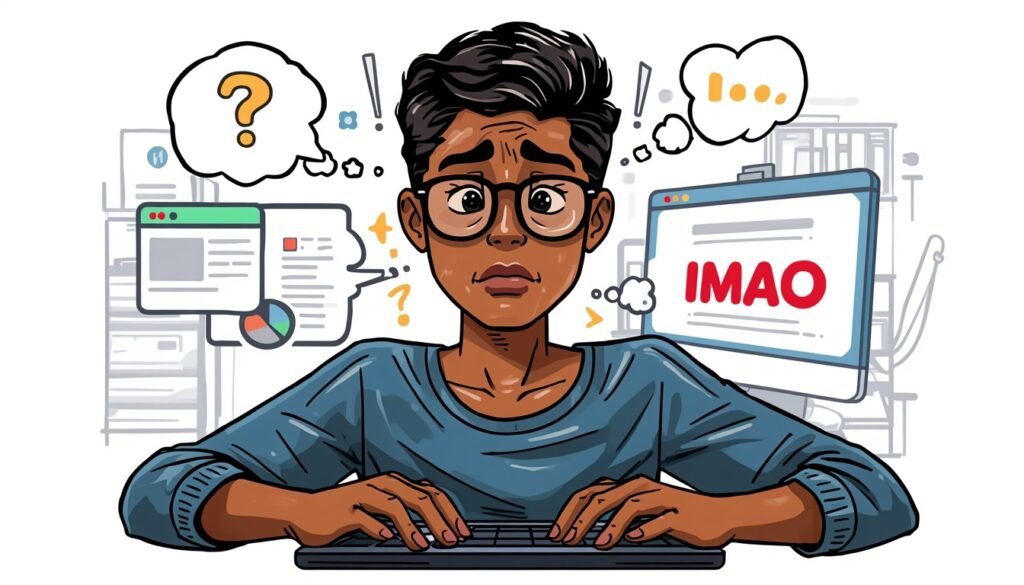
The meaning of IMAO can change slightly depending on the conversation.
Friendly Conversation
Example:
“That’s the best pizza restaurant in town, IMAO.”
Meaning:
“I really like this place, and I’m jokingly acting very confident.”
Online Debate
Example:
“Cats are better than dogs, IMAO.”
Meaning:
“This is my strong personal opinion, but I’m keeping it playful.”
Personal Joke
Example:
“I’m definitely the smartest person here, IMAO.”
Meaning:
“I’m teasing and pretending to brag.”
The surrounding words, emojis, and relationship between people all affect interpretation.
Common Misunderstandings About IMAO
Because IMAO is less common than other abbreviations, people often misunderstand it.
1. IMAO Does Not Mean LMAO
This is the most common mistake.
Although the spelling is similar, the meanings are unrelated.
- LMAO = laughter
- IMAO = opinion
2. IMAO Does Not Always Mean Someone Is Arrogant
The word “arrogant” sounds negative, but the abbreviation is usually ironic.
The person is often making fun of their own confidence.
3. IMAO Is Not Formal Language
It is internet slang. It should stay in casual conversations.
4. IMAO Does Not Mean “I Mean Also”
Some people assume it is random typing, but it is an intentional abbreviation.
IMAO Examples in Sentences
Here are more examples showing how people naturally use IMAO:
- “This is the best video game ever created, IMAO.”
- “Nobody makes better cookies than me, IMAO.”
- “Summer is obviously better than winter, IMAO.”
- “That singer deserves every award possible, IMAO.”
- “This is the most comfortable chair in the world, IMAO.”
- “I’m the best cook in this family, IMAO.”
- “That was the smartest decision you could make, IMAO.”
Each example combines an opinion with humor.
The important thing is not just the words before IMAO. The abbreviation changes the emotional tone of the entire sentence.
How Internet Slang Like IMAO Changes Communication
The growth of IMAO shows how language evolves in online environments.
Traditional language develops over years through books, education, and communities. Internet slang can develop much faster because millions of people communicate instantly.
Internet slang evolves through online communities, chats, and social platforms.
Users constantly create new expressions to represent emotions that are difficult to show through plain text.
Abbreviations such as IMAO, IMO, IMHO, and LMAO are examples of how people adapt language for digital spaces.
They make conversations faster, but they also add personality.
The Role of Tone in Digital Communication
One major challenge of texting is the absence of physical signals.
In face-to-face conversations, people understand meaning through:
- Voice changes
- Facial expressions
- Gestures
- Body language
Text messages remove those signals. Because of this, people use emojis, punctuation, and slang abbreviations to create emotional meaning.
IMAO is one example of a digital tool that helps communicate tone.
It tells readers:
“This is my opinion, but I’m not being completely serious.”
That small signal can prevent unnecessary misunderstandings.
Why Understanding IMAO Meaning in Text Matters Today

Digital conversations are now part of everyday life. People communicate through messaging apps, social networks, online communities, and professional platforms.
Understanding slang helps you:
- Avoid confusion
- Respond with the correct tone
- Understand online culture
- Communicate more naturally
As online language continues to change, new abbreviations will appear. Knowing how slang works makes it easier to understand future expressions too.
IMAO may seem like a small internet abbreviation, but it represents a larger trend: people constantly adapt language to fit new ways of communicating.
Frequently Asked Questions About IMAO Meaning in Text
What does IMAO mean in simple words?
IMAO means “In My Arrogant Opinion.” It is a humorous way to share a personal opinion while pretending to sound overly confident. Most people use it jokingly, not to actually appear arrogant.
Is IMAO the same as LMAO?
No. IMAO and LMAO have completely different meanings. IMAO means “In My Arrogant Opinion” and expresses an opinion, while LMAO means “Laughing My A** Off” and shows that someone finds something very funny.
Where is IMAO commonly used?
IMAO is mainly used in casual digital spaces such as text messages, social media comments, online forums, and gaming chats. It is informal slang and is generally not used in professional communication.
Is IMAO a positive or negative expression?
IMAO is usually neutral and playful. Although the word “arrogant” appears in the phrase, users normally use it as irony or self-aware humor rather than a serious insult.
