
There’s this strange quiet that falls over a house right before it’s sold. Not silence exactly, more like the walls are holding their breath, remembering all the rent checks, late-night repairs, tiny victories of real estate investment that stacked up over the years. If you’ve ever owned a rental property, you’ll know the feeling—it’s not just numbers, it’s a long story told in receipts and repaint jobs and slightly crooked cabinet doors.
And then, just when you think you’re about to celebrate a nice clean profit, someone (usually your accountant, who drinks too much coffee) leans in and whispers: “Don’t forget about Depreciation Recapture.”
Ah. That thing.
It sounds like a villain in a tax-themed drama, but really it’s just the IRS (Internal Revenue Service) politely asking for a piece of what you already enjoyed as tax savings. Not rude, exactly. Just… persistent.
So let’s walk through this together—messy, real, a bit tangled—so you actually understand how depreciation recapture works, not just in theory but in the way it affects your actual, lived, financial outcomes.
The Story Behind Depreciation (Why It Exists at All)
Before we get into the “recapture” bit (which sounds aggressive, I know), we gotta understand why depreciation even happens.
When you buy an investment property, the government assumes that the building (not the land, land’s stubborn like that) slowly wears out over time. Paint fades, pipes sulk, roofs sigh dramatically. Because of that, you’re allowed to take Depreciation Deductions each year, reducing your Taxable Income.
It’s like the tax system saying, “Yeah okay, your property is aging, we’ll cut you some slack.”
So every year, you claim a portion of the property’s value as Asset Depreciation, lowering your Tax Liability. It’s one of the quiet joys of property ownership, honestly. Feels like getting away with something, even though you’re not.
But—here’s the catch—you don’t get to forget about those deductions when you sell.
Nope. The system remembers.
What Is Depreciation Recapture (And Why It Feels a Bit Unfair)
Alright, here’s the core idea, no fluff:
When you sell your rental property, the IRS looks at all the depreciation you claimed over the years and says, “Cool, now we’re taxing that portion.”
That tax is called Depreciation Recapture, and it’s typically taxed as Ordinary Income, up to a maximum Tax Rate (25% Depreciation Recapture Rate).
So yeah, that sweet tax break you enjoyed? It gets partially “recaptured” later.
It’s not exactly unfair, but it feels unfair when you’re staring at your closing statement thinking you made more than you actually get to keep.
And this is where things start getting interesting, because now we need to talk about how everything is calculated.
How Adjusted Basis Shapes the Whole Outcome
This is where people’s eyes glaze over a bit, but stick with me—this part is actually kinda powerful once it clicks.
Your Adjusted Basis is basically your property’s starting value (your Purchase Price) plus any Capital Improvements, minus all the Depreciation Deductions you’ve taken.
There’s a rhythm to it:
- Start with what you paid
- Add what you improved
- Subtract what you claimed
And boom—you get your Adjusted Cost Basis.
This number matters a lot because it directly affects your Total Gain when you sell.
If your adjusted basis is lower (because you took a lot of depreciation), your gain looks bigger. Bigger gain = bigger Tax Burden.
It’s a bit like eating dessert for years and then getting handed the calorie count all at once. Delightful… until it isn’t.
The Gain Calculation (Where Numbers Start Talking Back)
Let’s put it together in a way that actually feels real.
Your Gain Calculation Formula looks something like:
Sale Price – Adjusted Basis = Total Gain
Now, that Total Gain gets split into two pieces:
- The part related to depreciation → taxed as Depreciation Recapture
- The rest → taxed as Long-Term Capital Gains
So you’re not just dealing with one tax. You’re dealing with layers of taxes. Like a lasagna, but less comforting.
And depending on your Filing Status (Single / Married Filing Jointly), your Capital Gains Tax rate might vary, which makes timing and planning weirdly important.
Depreciation Recapture Tax Rules You Shouldn’t Ignore
The IRS Regulations around this are pretty clear, even if they feel complicated at first glance.
Here’s what matters:
- All depreciation taken must be accounted for, even if you “forgot” to claim it
- Recapture applies specifically to the depreciation portion of your gain
- It is taxed separately from standard capital gains
- You cannot just wish it away (many have tried, none succeeded)
This is why Tax Reporting and solid Record Keeping matter more than people expect. Lose track of your numbers, and suddenly you’re guessing—and guessing is expensive.
Why Property Appreciation Doesn’t Tell the Whole Story
People love talking about Property Appreciation. “My property doubled!” they say, glowing like they’ve discovered fire.
But appreciation alone doesn’t determine your Financial Outcomes.
Because once you factor in:
- Depreciation Recapture
- Capital Gains Tax
- Selling costs
- Possible Mortgage Considerations
…the picture shifts.
A lot.
This is why experienced investors don’t just chase appreciation—they focus on Tax Planning and smart Property Transactions.
Because what you keep matters more than what you make on paper.
Smart Tax Planning for Depreciation Recapture
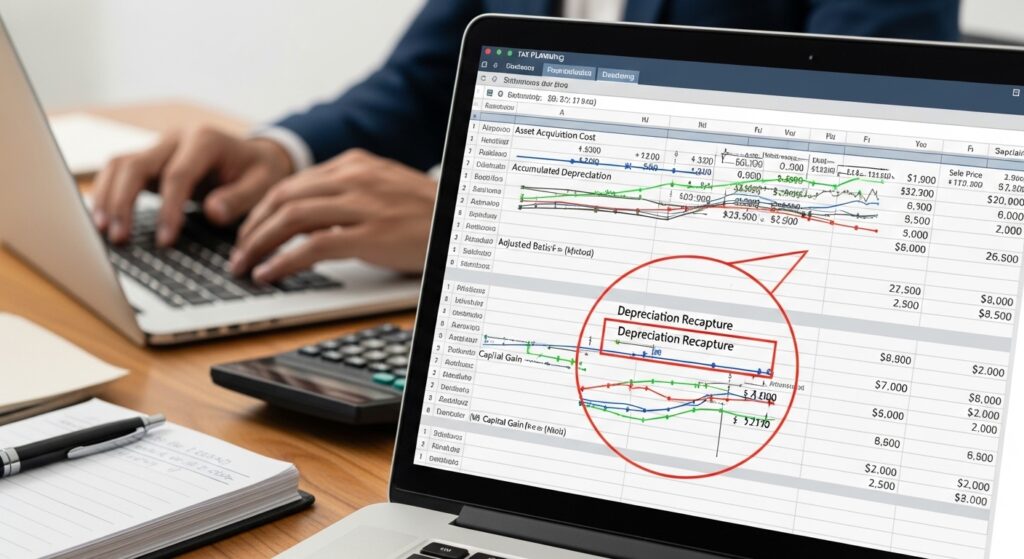
Now we get into the part where things feel a bit more hopeful.
There are ways to soften the impact of Depreciation Recapture, and they mostly fall under the umbrella of good Tax Strategies.
Some common approaches:
- Timing your sale based on income (hello, Income Timing Strategy)
- Offsetting gains with losses elsewhere
- Working closely with a Tax Professional / Advisor
- Structuring deals carefully
None of these are magic tricks, but together they can reduce your overall Tax Liability in meaningful ways.
It’s less about escaping taxes and more about navigating them intelligently.
Using a Like-Kind Exchange (1031 Exchange) to Defer Taxes
Ah yes, the famous Like-Kind Exchange (1031 Exchange)—a favorite tool in the real estate investment world.
This strategy allows you to sell one investment property and reinvest the proceeds into another, deferring both Depreciation Recapture and Capital Gains Tax.
Not eliminating. Deferring.
Important difference.
The rules (often referred to as 1031 exchange rules) are strict:
- You must reinvest in a similar type of property
- There are tight timelines
- Funds must be handled by a qualified intermediary
But when done correctly, it’s one of the most effective ways to manage Deferred Taxes and keep your money working for you.
It’s like telling the IRS, “Not today,” in a very polite, legally approved way.
Converting Rental Property Into a Principal Residence
Here’s a strategy that feels almost poetic.
Some investors convert their rental property into a Principal Residence, live in it for a few years, and then take advantage of the Home Sale Exclusion.
That exclusion allows:
- Up to $250,000 (single)
- Up to $500,000 (married filing jointly)
…of gain to be excluded from taxes.
Now, here’s the twist: Depreciation Recapture still applies.
Yep. You can’t fully escape it this way.
But combining this with the home sale tax exclusion rules can still reduce your overall Tax Implications significantly.
It’s a bit of a hybrid strategy—part lifestyle, part math.
Common Mistakes People Make (And Quietly Regret)

There are a few patterns that show up again and again:
- Ignoring depreciation during ownership
- Poor Record Keeping of Capital Improvements
- Underestimating the Tax Burden at sale
- Not consulting a Tax Professional / Advisor early enough
- Misunderstanding how Adjusted Basis Formula Rental Property works
And the biggest one?
Thinking the sale price equals profit.
It doesn’t. Not even close.
A Quick Real-Life Style Example
Imagine you bought a property for $200,000.
Over time:
- You claimed $50,000 in Depreciation Deductions
- You added $20,000 in Capital Improvements
Your Adjusted Basis becomes:
200,000 + 20,000 – 50,000 = 170,000
Now you sell it for $300,000.
Your Total Gain is:
300,000 – 170,000 = 130,000
Out of that:
- $50,000 is subject to Depreciation Recapture
- $80,000 is taxed as Long-Term Capital Gains
See how the story changes once you run the numbers?
Yeah. It sneaks up on you.
How to Make Smarter Decisions Moving Forward

If you’re still reading this, you’re already ahead of most folks, honestly.
Here’s what tends to help:
- Keep detailed financial records (future you will be grateful, like genuinely grateful)
- Understand your Tax Code obligations early
- Plan exits before you even enter a deal
- Think long-term, not just at the moment of property sale
Because real estate isn’t just about buying and selling—it’s about managing the full lifecycle of a real estate investment.
Final Thoughts (A Little Messy, A Little Honest)
Selling a rental property isn’t just a transaction—it’s the closing chapter of a long, slightly chaotic financial story. And Depreciation Recapture? That’s just part of the ending. Not the villain, not the hero, just… there.
If there’s one thing to take away, it’s this:
Numbers don’t lie, but they do surprise you if you haven’t been paying attention.
So pay attention.
Run the calculations. Ask questions. Maybe even enjoy the process a bit (okay that might be pushing it).
And if you’ve been through this already—what caught you off guard? What would you do differently next time? There’s something weirdly comforting in sharing these stories, even the slightly painful ones.
Because at the end of the day, wealth building through real estate isn’t just about profit—it’s about learning how the system moves, and moving with it, even if a little clumsily at first.
